What is a lien waiver?

 General availability in select markets (United States)

Flag Us Procore Pay is available in the United States. It is designed for main contractors and owner-builders who act as their own main contractors on a job. Procore Pay extends the payment application management functionality in the Procore web application to handle the payment process between main and specialty contractors.
Answer

A lien waiver is a legal document signed in exchange for payment that waives the signer's right to file a lien for the amount specified in the waiver. A lien is a legal claim filed by a contractor or supplier against the property. The property is used as collateral to satisfy the debt(s) to the downstream collaborator(s). See What is a downstream collaborator?

In the simplest terms:

  • A lien protects a contractor or supplier from not getting paid.

  • A lien waiver protects the property owner from a lien.

Example

An owner-builder acting as their own main contractor on a job or a main contractor hires you, the specialty contractor, to perform work on a construction project. As the specialty contractor, you possess the right to file a lien against the owner's property until the owner-builder or main contractor pays you for your work. Any subcontractors or suppliers that you hire to perform work or deliver materials on the job site also have the right to file a lien against the property, which serves as collateral for the work and/or materials they provide. A lien waiver signifies that a contractor (a main contractor, a specialty contractor, a subcontractor and/or a supplier) has released their right to file a lien against the property.

Common Questions

Who provides a lien waiver?

In the United States, a signed lien waiver is typically provided by anyone working on a job site. This includes vendors who supply materials for a construction project and any specialty contractors or subcontractors who are not being directly paid by the property owner. With Procore Pay, a project's downstream collaborator(s) submit their lien waivers to the general contractor who is managing the project in Procore. Lien waivers are generated with the invoice that is submitted in the Project level Invoicing tool. See Create a Subcontractor Invoice.

Why provide a lien waiver?

On constructions projects, lien waiver provide these legal and financial protections to the contract parties:

  • Collect lien waiver from downstream collaborator to ensure lien won't be filed against the property owner.

  • provide lien waivers to upstream collaborators to get paid.

What types of lien waiver templates can you create in Procore?

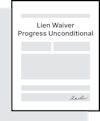
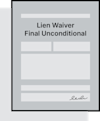
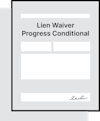
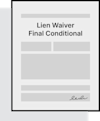
With Procore Pay, payors can create four (4) different types of lien waiver templates to use on their construction projects: Progress Conditional, Progress Unconditional, Final Conditional and Final Unconditional. See Create lien waiver templates.

Progress

Final

Conditional

Lien Waiver Type Progress Conditional

Used for progress payment on a job. Waiver effective when signed.

Lien Waiver Type Final Conditional

Used once for final payment on a job. Waiver effective when signed.

Unconditional

Lien Waiver Type Progress Unconditional

Used for progress payment on a job. Waiver effective when payment is received.

Lien Waiver Type Final Unconditional

Used once for final payment on a job. Waiver effective when payment is received.

How are lien waivers categorised?

Lien waivers are generally grouped into these categories:

Progress waiver

A progress waiver is provided to the property owner by the downstream contractor(s) and supplier(s) with a progress billing. A progress billing is an incremental payment application submitted by a downstream collaborator to the upstream collaborator (see What is a upstream collaborator?). Progress billing helps to ensure that downstream collaborators get paid for work completed throughout a construction job, particularly on jobs that take years to complete.

  • If you are working on a longer job (i.e., more than a few months), downstream contractors generally provide a progress lien waiver to the property owner at the end of each valuation period. Typically, Payment Applications is performed monthly. However, Payment Applications timelines can vary, depending on the payment terms in the contract.

Final waivers

A final waiver is provided to the property owner one time. Typically, at the end of the construction job, with a final billing. A final billing is the last payment application submitted by a downstream collaborator to the upstream collaborator at the end of a project.

  • Downstream collaborators provide a final lien waiver at the end of the job.

Conditional waivers

A conditional waiver is sent to the property owner before payment. It indicates the downstream collaborator is willing to waive their lien rights on the condition of getting paid.

  • In the United States, contractors typically send lien waivers every thirty (30) days. The common practice is to send the lien waiver when the payment application is issued.

Unconditional waivers

An unconditional waiver is sent to the property owner after payment is made. It indicates the downstream collaborator is willing to waive their lien rights, even if they don't receive payment from the property owner.

  • In the United States, executing and processing lien waiver can take several months. The common practice for main contractors is to send lien waiver after being paid for their work by the owner. However, practices can vary.

See Also

Loading related articles...